Webb image archive
Supermassive Black Holes
Through studying the early universe, NASA’s James Webb Space Telescope has brought us closer to understanding one of the most prominent theories that explain the origins of s...
- Date
- Oct 9, 2026
- Observatory
- James Webb Space Telescope
- Credit
- NASA / ESA / CSA / STScI
- Archive ID
- supermassive-black-holes
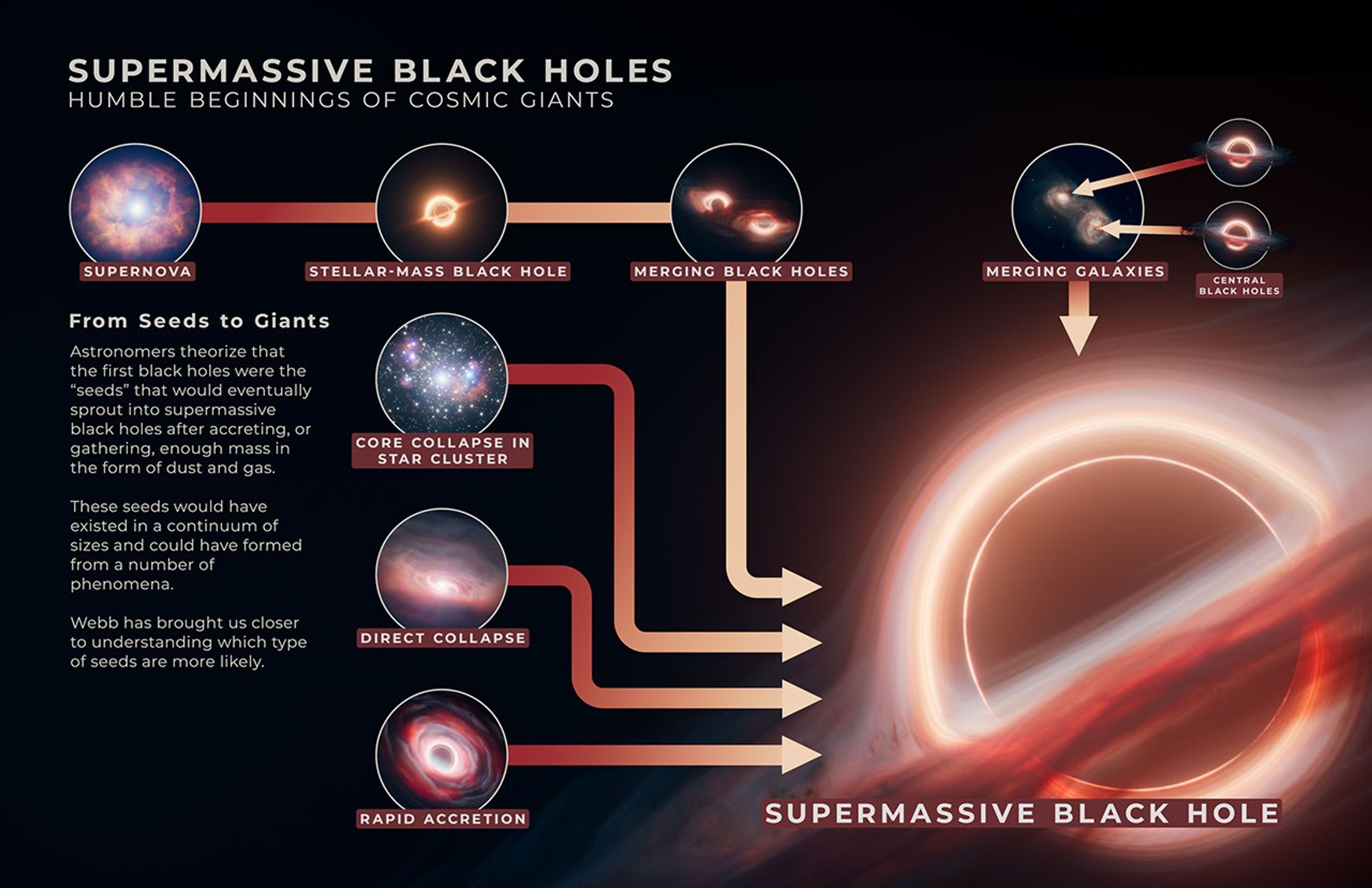
Through studying the early universe, NASA’s James Webb Space Telescope has brought us closer to understanding one of the most prominent theories that explain the origins of supermassive black holes, that of black hole “seeds.” There are two main types of seeds, light seeds and heavy seeds, with a continuum of sizes between them.
Many light seeds are theorized to form from stars that are several times more massive than the Sun, which became supernovae, or by merging with other light seeds. Most heavy seeds, on the other hand, are thought to form due to the direct collapse of stars tens of thousands of times more massive than our Sun or from runaway collisions of millions of stars. Over millions of years, these seeds would grow through the rapid accretion of matter, like dust, gas, and even stars, and eventually become supermassive black holes.
Extended Description and Image Alt Text
Extended Description
Infographic titled “Supermassive Black Holes, Humble Beginnings of Cosmic Giants.” There are five pathways within four rows of images and illustrations, each enclosed in a white circle, with an arrow that has an orange-to-yellow gradient extending from each pathway. Each arrow points to an illustration in the bottom right, labeled “Supermassive Black Hole.” This supermassive black hole illustration appears as a black circle surrounded by a bright white layer that slightly dims further away from the circle. A dense filament of red dust cuts in front of this circle at a 30-degree angle.
- The top row includes two separate pathways, one beginning at the left of the infographic and one beginning at the right. At the left are an image of a fuzzy, bright white core surrounded by a cloud of orange, labeled “Supernova,” a smaller version of the illustration of the supermassive black hole, labeled “Stellar-Mass Black Hole,” and an illustration of two of these black holes near each other, labeled “Merging Black Holes.” These images are all connected by one arrow, which points to the supermassive black hole illustration. At the right, above the supermassive black hole illustration, are two illustrations of black holes, labeled “Central Black Holes” with arrows that point to the centers of two off-white, fuzzy, circular objects, which are two galaxies, labeled “Merging Galaxies.” An arrow points from the merging galaxies to the supermassive black hole illustration.
- The second row contains a third pathway. It shows an image of a group of fuzzy bright white stars of different sizes, with the brightest being at the center labeled “Core Collapse in Star Cluster.” An arrow points from this image to the supermassive black hole illustration.
- The third row contains a fourth pathway. It shows a bright white spot that lies in the center of a dense cloud of orange gas and dust. This illustration is labeled “Direct Collapse.” An arrow points from this illustration to the supermassive black hole illustration.
- The last row contains a fifth pathway. It shows an illustration of a black hole surrounded by swirling red and white dust and gas labeled “Rapid Accretion.” An arrow points from this illustration to the supermassive black hole illustration.
Underneath the first row and to the left of the second, third, and fourth rows is text titled “From Seeds to Giants.” Below the title is the following text: “Astronomers theorize that the first black holes were the ‘seeds’ that would eventually sprout into supermassive black holes after accreting, or gathering, enough mass in the form of dust and gas. These seeds would have existed in a continuum of sizes and could have formed from a number of phenomena. Webb has brought us closer to understanding which type of seeds are more likely.”
Image Alt Text
Infographic titled “Supermassive Black Holes, Humble Beginnings of Cosmic Giants.” There are several rows of images and illustrations that represent ways that black holes can form and eventually become supermassive black holes.